The Darkening of Valinor (and other odds and ends)

Firstly, I’m finally drawing again – there’s still a whole load of tests that need to be marked over the next month, but most of the other work is out of the way.

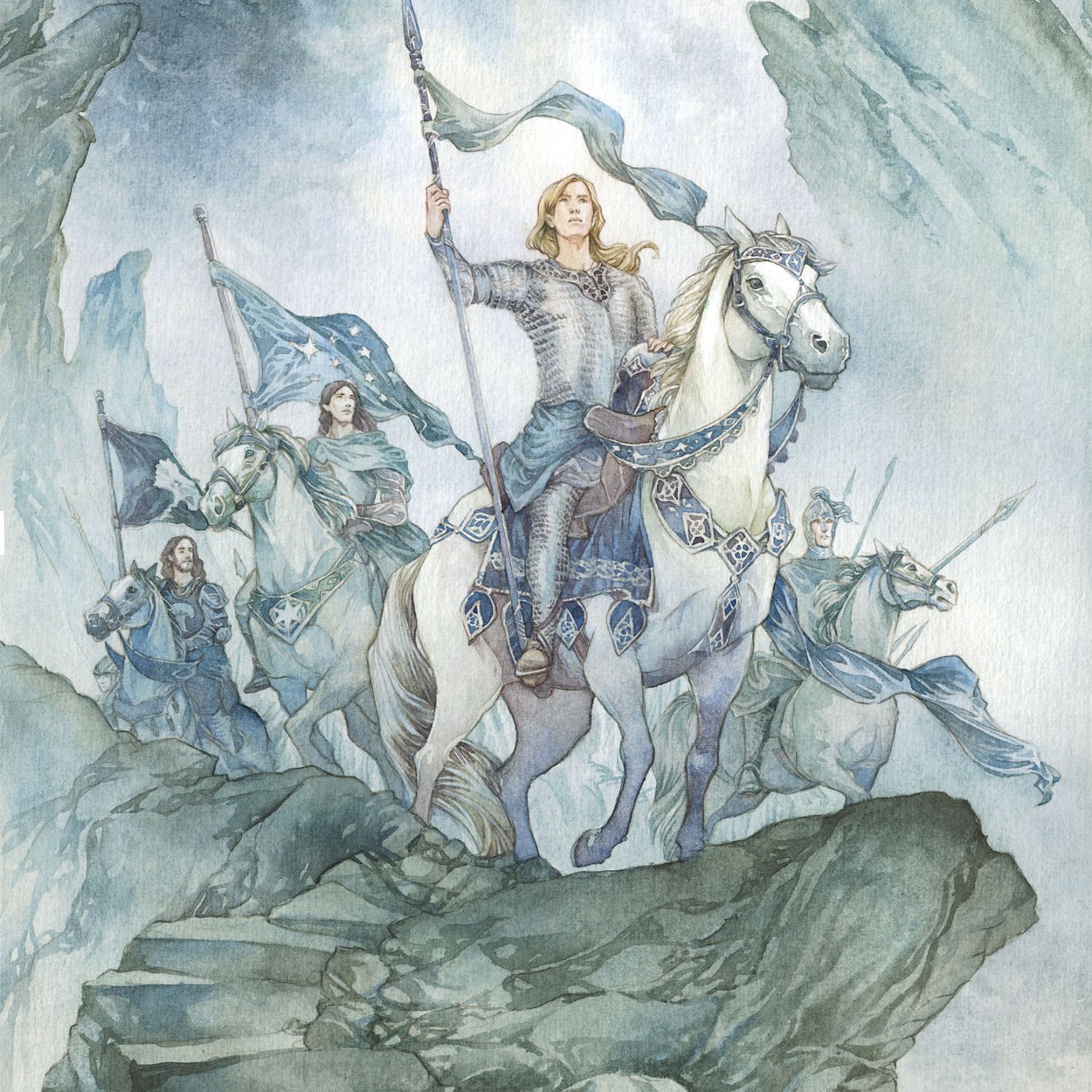
This is a commission about the Darkening of Valinor – this will be the centre piece, with Fëanor holding his dead father.

wp_finwe_headraised2

My latest print sale has been a huge success – thank you, all of you who have supported me by buying my prints! The print sale is still up; if you’ve been debating so far, you have until tomorrow to make up your mind. :)

And lastly: I’ve now got a tumblr! I’m still in the process of making up my mind what I’ll post where, but I can imagine that random sketches and wips will go to tumblr rather than my blog – unless it’s walkthroughs, of course. I’ll still do those here. :)

Print Sale!

wp_printsale

From today until May 7, 2013, all prints are special price!

Regular A3 print with white border: 12€

A5 Facsimile pastel print: 22€

A3 facsimile print on watercolour paper with gold paint (no white border): 65€

A3 + Remarque print (with white border and pencil drawing added by hand): 35€

See examples of prints

I ship worldwide! Shipping (international OR within Germany): 4€ (or 2,50 for A5 prints). No additional cost for more than one print (unless it’s more than six, or four watercolour facsimiles).

HOW TO ORDER

I have no checkout function on my website (yet), so this works via Email.

Send me a mail with what prints you’d like (title, what type (A3 regular, facsimile, remarque…), and how many). If PayPal doesn’t have your correct address, please let me know in your email too.

When you pay by PayPal, please include the following information in the comment box: Titles of prints and your name.

I often process several very similar print orders at the same time, and if the name in PayPal doesn’t match the name in the email (which frequently happens when using family members’ accounts, for example), I don’t know who has paid me and for what.

All my prints are sent in a cardboard-backed envelope with more cardboard protection inside.

Watercolour Workshop 2013

banner_blog_maglor.jpg

FIRST WORKSHOP: August 17th/18th; one weekend (Saturday and Sunday); eight hours on both days (10-18.00)
SECOND WORKSHOP: August 24th/25th. Should anyone wish to come to all four dates, that will be possible too.
WHERE: Youth Hostel Aachen, Germany.
WHAT: You’ll learn the basics of how watercolour works, along with an assortment of colour theory, special tricks in watercolour, get the chance to try out different sorts of paint (I’ll bring every variety I have and you’re free to give them all a try) and things like masking fluid and other gimmicks, plus anything you’d specifically like addressed. The approach that I’m going to show you is very much lineart-based, so it’s a good idea to bring some lineart with you (on watercolour paper).
HOW MUCH: 60 Euros per participant. The workshop fee covers only the workshop, not your accommodation or journey!
WHO: Anyone who reasonably thinks I can still teach them something about watercolour. Total beginners are very welcome, as are non-German speakers. I held the last workshops mostly in English, but either English or German is a must.

If you have questions, just write a comment here!

If you want to come, please send me an email with:
:bulletblue: “Workshop” and your name in the title, as well as a 1 or 2 depending on whether you’d like to come on the first or the second weekend
:bulletblue: name and/or nickname I’ll recognise (in case I’ve known you under a nickname for years)
:bulletblue: skill level in watercolour
:bulletblue: languages spoken
:bulletblue: vegetarian or other food specifics like allergies etc
:bulletblue: email address (so I can copy them all into one word document)
:bulletblue: anything specific you’d like to learn from me.

Please note that the definite registration is an email you send me (to jenny@goldseven.de). When I’ve answered it, you know that you’re in. Posting in the comments here, on deviantArt, Comicforum or Facebook is not definite until I get mail from you!

See you in August! :)

Out soon: “Songs of Sorrow and Hope – The Art of Jenny Dolfen”

I’m proud to announce that my first artbook, entitled “Songs of Sorrow and Hope”, will be published by Oloris Publishing this summer!

Click here for the official announcement from Oloris

Watch this space for more information on publishing dates and how to order. And probably signed copies. And thank you so much for your support – you know who you are! *hugs*


Welcome to my life, Quinacridone!

A few people recommended Daniel Smith watercolours to me when I posted my last blog post. I got curious and found a place to order them online in Germany. I got myself Shadow Violet, Quinacridone Deep Gold and Indian Red (which I’d run out of anyway). The owner of the shop very kindly also included a couple of “dot cards”, watercolour paper with dried paint dots on it, which you can try out for yourself. And wow – am I hooked! Especially the Quinacridone hues are amazing – completely transparent, light-fast and wonderfully vibrant and alive.

wp_quin

In the corner, I tried some Shadow Violet (with masking technique). The hues you see there are for real. Just wow.

I also got myself some Fabriano paper, as I was running out of Montval. Fabriano, for me, is a real discovery – as grainy and cottony as Arches, but without the latter’s setbacks (I could never get dark colours on Arches). Together with a new watercolour technique book by Roland Roycraft, I suddenly found myself wanting to try it all out at once – new technique with masking fluid, my new Daniel Smith colours, my new Fabriano paper, and leave out lineart and paint loosely, while we’re at it.

With all those novelties, it was clear who’d be my guinea pig.

wp_maedh-test

I still managed to totally warp the proportions (no lineart! Heeeelp!), so thanks for the miracles of Photoshop’ liquefy tool. :D

The colours are 100% original. Let’s just pretend the face looks like this too.

Which watercolours?

An overview over all the different watercolour types and brands I’ve worked with, their advantages and setbacks.

Some general notes in advance. If you’re well-versed with the different features of watercolours, just skip this bit.

Quality: Watercolours come in two general distinctions: Artists’ quality (Fine Art/Künstler) or students’ quality (Akademie). All the paints I’ll be talking about here are artists’ colour quality. They’re generally more light-fast (unless noted below), and more highly pigmented. A pan of student’s quality watercolour lasts me two months. The same size pan with artists’ quality lasts me six. If you’re unsure whether you want to experiment with watercolour, by all means buy students quality. Once you’re sure you want to do more with them, and want your final products to be light-fast, go for artists’ quality.

Light-fastness: A colour that is light-fast doesn’t fade if exposed to sunlight. Some natural pigments like Crimson are less light-fast than others; they’ll fade over time. Some manufacturers of watercolours use traditional, natural pigments as well as synthetic ones that have been made for more light-fastness. If you’re going to paint just for fun, or colour comics, or any other type of illustration that is going to be reproduced, light-fastness won’t be a huge concern of yours. If your paintings are going to end up on a wall, better make sure your pigments are light-fast. More detail on each type of paint below.

Opacity: Most watercolours are more or less transparent. This means that if you paint them over an already dried glaze, or over lineart, you’ll still see what’s below. Many earth pigments are more opaque. There’s nothing good or bad about opacity or transparency. Opaquer colours result in a more solid look close to gouache or even acrylics; more transparent colours will look lighter, more feathery, and probably more watercolour-y. If you have a tendency to produce very muddy paintings, make sure you pick transparent pigments. Darker colours will look deeper in transparent paint – because they shine more, even when they’re dark. More detail on each type of paint below.

Different brands: For full, comprehensive and excellent information on many international paints, refer to this section of handprint.com.

1. Pans (Schmincke)

tut_mat1

Type: Pretty much what most people know as watercolours. Little cakes of dry paint that you wet with a brush and then paint with.

Where to get them: Artists supplies online or offline. Other good brands include but are not limited to Daniel Smith, Lukas, Daler-Rowney, Winsor&Newton, Van Gogh. My American friends recommend M Graham, but I’ve never tried those.

Result: Varies. With transparency or opacity (see below), many different looks from light to more substantial can be achieved.

Light-fastness: Varies. On the package when you buy them, there are symbols that tell you how light-fast they are. For Schmincke, it’s a number of stars (see below, too). In my experience, Schmincke paints are very light-fast (even if the number of stars says they aren’t). For example, I stared conducting a light-fastness test in the summer of 2010, and not even the Alizarin Crimson or Indigo, which are supposed to be very fugitive, have faded after being exposed to sunlight for years.

Opacity: Varies. There’s another symbol that tells you how transparent or opaque any given pigments are. For Schmincke, a black square means very opaque; a white square means very transparent. Transparent vs opaque paint can result in very difficult final paintings. On average, most Schmincke paints are more transparent than not.

Useful for: Working in small formats, especially in the open. You can take a watercolour box anywhere and have all the paints handy without unscrewing lids.

Not useful for: Painting very large areas, mixing a lot of paint.

2. Tubes (Schmincke)

tut_mat2

Type: Semi-liquid paste that you squeeze on a palette to paint with. Dried paint is infinitely reusable, just re-wet it.

Where to get them: Artists supplies online or offline. Other good brands include but are not limited to Lukas, Windsor&Newton, Van Gogh.

Result: See above. Schmincke paints from tubes and pans are otherwise identical.

Light-fastness: See above.

Opacity: See above.

Useful for: Working in small large formats, to mix large amounts of paint at the same time. When I started to work in formats larger to A4, I switched to tubes permanently.

Not useful for: Travelling. At least severely limited in comparison to pans.

3. Watercolour pencils (Dürer, Koh-I-Noor)

tut_mat3

Type: Coloured pencils with “pan” watercolour instead of leads. They handle a lot like normal coloured pencils, but you need less pressure; they tend to be very bright. After drawing, you go over selected areas with a wet brush to soften edges and brighten colours.

Where to get them: Artists supplies online or offline.

Result: If little water is used, similar to a coloured pencil image. If much water is used, very bright colours.

Light-fastness: Depends on the pigments used; it can be difficult to find out which exactly were used, as watercolour pencils rarely name the pigments, as opposed to good quality pan or tube manufacturers.

Opacity: More opaque than regular watercolours, and always more irregular surfaces. You can get very dark, bright colours much more easily than with tube or pan paints.

Useful for: People who prefer a drawing approach to actual painting, people who like a look of single strokes.

Not useful for: Me. ;) They’re not my cup of tea.

4. Rohrer & Klingner liquid watercolour

tut_mat4

Type: Rather thick liquid in a glass bottle, with a very practical eye-dropper in the lid. Insanely highly pigmented. One drop fills an entire background. I usually place one drop onto a palette and then thin it down. These are also reusable when they’ve dried.

Where to get them: In Germany: big (!) artists stores like Boesner, or online at Gerstaecker or Boesner. I don’t know about outside Germany.

Result: Very bright colours.

Light-fastness: Varies (they’ve got these little stars too).

Opacity: Extremely opaque if used undiluted. If used with more water, almost as transparent as pan or tube watercolour (but not quite). If applied very thickly, the paint (even blue and red etc) acquires a thick and oily bronze sheen.

Useful for: Filling large areas very economically.

Not useful for: Households with cats if you forget to screw the lid back on. If one of these beauties spills over, say good-bye to anything on your workbench that is not a wipeable surface.

5. Talens Ecoline liquid watercolours

tut_mat5

Type: Rather thin liquid in a glass bottle; no eyedropper lid, which is a severe setback. You see that I’ve filled my Ecolines into pharmacy bottles. Reusable when dried, but as opposed to the tubes and Rohrer& Klingner above, they get noticeably thinner if re-wetted.

Where to get them: I’ve only ever found these online; they seem to be pretty internationally available.

Result: Very bright, very transparent colours.

Light-fastness: Not light-fast. Don’t use if you want to put a finished painting on a wall. Fine for reproduction.

Opacity: Very transparent, incredibly bright colours. (The white up there is opaque, of course, though not as opaque as gouache.)

Useful for: Brightly coloured, transparent paintings that are done for reproduction and don’t need to be light-fast.

Not useful for: I think I addressed the light-fastness thing…

6. Dr. Ph. Martin’s HYDRUS watercolours

tut_mat6

Type: Liquid in a glass bottle (or in a plastic bottle); with eyedropper lid. If you buy them, go for the glass bottles (they’re the larger ones). I’ve had some bad luck with he plastic ones – paint drying up, flaking, or evaporating. And whereas tube or pan watercolour can be re-wet and re-worked ad infinitum, once Hydrus has flaked, that was it. I haven’t had this problem with the larger glass bottles at all. They can be re-wet like any other watercolour.

Where to get them: Not in Germany. =( They’re available in the US, for example online with Dick Blick. That’s where I get mine.

Result: Very bright colours that allow darker shading than most watercolours. If applied in many layers and undiluted, becomes rather opaque.

Light-fastness: Light-fast. Says the lid. I’ve been working with them for a year and so far, I agree.

Opacity: Transparent when diluted, though ever so slightly less so than pan or tube colours. Rather opaque when used in many layers and/or undiluted. Can be used to great effect in combination with pan or tube paints.

Useful for: Anything! Easy to administer, bright colours, dark colours, you name it, they got it.

Not useful for: Like all bottled paints, travelling with them is a nuisance if you don’t have a table to work on.

The harp no longer sings

wp_harp_col

This is a concept that has occupied me for years, resulting in several pieces already. It’s symbolic rather than illustrative of any given passage in the text – Maglor, a remnant of the Elves in Middle-earth but excluded from his people, caught in a world of his own where music no longer brings consolation, surrounded by the ruins of the former greatness of the Noldor, whose downfall he had a part in.

I’ve never really done much with the “ruins” part of the scenario; half-hearted attempts at best, probably because I really struggle with architecture of any kind. Now, though, I’ve decided to give it another go.

This is a more refined version of the first sketch.

wp_harp3

Here’s the lineart:

wp_harp_ln

When I print the lineart, I tint the ruins in the background more greenish and very light, so that it will mostly disappear in the finished painting, and reduce the ruins to faint structures that could just as well be from a dream.

tut_harp1

This picture is a great excuse to make excessive use of my new Cobalt Turquoise from Schmincke. For the first background wash, I mix it with Chrome Oxide Green and a touch of Ultramarine and Cadmium Yellow, and apply it very thinly with a soft brush, lighter at the top and darker at the bottom.

tut_harp2

I then re-wet everything, and paint darker streaks, that will look like sunlight filtering through tress – or through water. I want the whole lighting here very ambiguous.

tut_harp3

After this has dried, I use the same colours – more green here, more blue there – very thinly to paint the detail in the ruins.

tut_harp4

To make it less monochromatic, I go in with a bluer tone, and paint the shadows in the areas between the streaks of sunlight. This is the point where my camera decides “This is all just green. Yeah, whatever.” I hope my scanner is more sensitive later…

tut_harp5

In all the following, excuse the turquoise colour mash, please.

Next, I add some Ochre to everything in the foreground – first the structures, to suggest sandstone or a similar stone.

tut_harp6

It gets a greenish-blue layer for shadows, to make it stand out less. I then decide Ochre will make a great foundation for the figure too. This looks very yellow now, but will mostly vanish under the greens and blues of Maglor’s clothing later, only serve as a “grounding” in the light situation around him.

tut_harp7

Some detailing in the ground – mainly with Ultramarine and duller Indigo, but with the brush dipped into Chromoxide Green, Cobalt Turquoise, and Ochre here and there for colour variation.

tut_harp8

Detailing on the leaves, again with the whole range of greens and blues used above.

tut_harp9

The skin is done with Burnt Sienna, as usual, but thinned down beyond recognition with my dirty water, which is now a nice green-blue concoction, rather thick too, as it’s dried overnight. Comes in extremely useful for making any colour fit the mood of my painting.

tut_harp10

I use the same principle with the hair tone, which is Sepia with a lot of dirty green water. The shadows are done with a touch of Indigo, too.

(Give my camera a kick here, please. Thanks.)

On the image on the right below, I’ve re-drawn the eyes and brows slightly with a Sepia marker, as the lineart was starting to dull under the paint.

tut_harp11

Below left: Next, I put in the base tones, very light, of Maglor’s clothes. I choose a mix of Cobalt Turquoise, Ultramarine, and Chromoxide Green for his tunic, and a more Indigo-heavy tone for the cloak. The hose is just my dirty water at this point. ;)

Below right: First layer of rendering. I build the shadows up slowly, mostly with Indigo, to avoid getting too dark too soon, and adding another layer here and there to add depth.

tut_harp12

Below: detailing on the arm guards. (I love doing Maglor’s arm guards.)

tut_harp13

After darkening and shading, and detailing, we arrive at this.

tut_harp13a

Final touches include painting the falling petals with white gouache.

tut_harp14

Follow

Get every new post delivered to your Inbox.

Join 1,990 other followers

%d bloggers like this: